We already knew the revolution was underway…but now it’s confirmed. ChatGPT is soon to release SearchGPT, its very own search engine that is set to compete with the big players like Google, Bing and Firefox.
The way we search for information online has been undergoing a dramatic transformation, driven by the rapid advancements in artificial intelligence. ChatGPT is at the forefront of this technology, interacting with users in a way that provides the perception of true conversation…with a non-human.
You can ask GPT anything, and it will have an answer. And while there are many examples where the answer has (let’s be polite) not been entirely accurate, or sometimes even appropriate, the technology has blown minds with its rapid responses and articulation of complex issues.
Now imagine that chat power in a search engine format…
“SearchGPT, can you please tell me what gigs I can take my young kids to on 20th August 2025?”
This sounds like a simple enough question. But go ahead, ask Google the same thing…what do you get? Ummmmm…

I’m pretty sure that’s illegal. Point is, the more specific you are with Google at the moment, the more likely you are to get nonsense in return.
While Google, Bing, Ecosia, Firefox and others have worked hard to improve the specificity of answers, there is nothing that can compete with the clear responses you receive when you ask ChatGPT a specific question.
ChatGPT can’t yet answer the above question, instead it suggests where you might find that information, though when you specify a location it gives it a good go. However, when it becomes a search engine, rather than a number of non-specific gigs around that date, or a number of websites I could check, will SearchGPT give me the very specific gig information I need? That’s what I would expect.
So how does this change how people will search? And how will it change how business owners will need to show up online? Here’s my hypothesis…
1. Specifics increase in importance
It’s very difficult to tell how businesses will show up on a revolutionised search engine without actually seeing it, but one thing is for sure. If your business doesn’t have the correct information to crawl, it’s very unlikely to show up on SearchGPT. With very specific searches made possible, very specific information will be required to make the cut. The potential is that technical specifications and intricate detail will provide you with greater scope to appear in search results. Take, for instance, a niche request for a product:
“SearchGPT, can you please find me a neon pink jumper with puff sleeves from a company that only uses natural dyes and ethically sourced material, in size 10 and that costs no more than £40?”
From the above, you can see that the more someone specifies in their request, the more information you would need to satisfy their requirements.
Is that any different to existing search engines? Well yes. Currently, loosely related content still has a chance of surfacing in a Google search, particularly if the website already has high authority. The Google SERP hierarchy is determined by a number of parameters and it doesn’t necessarily take on board everything that you ask for.
I asked Google for that specific search, and here’s what it came up with:
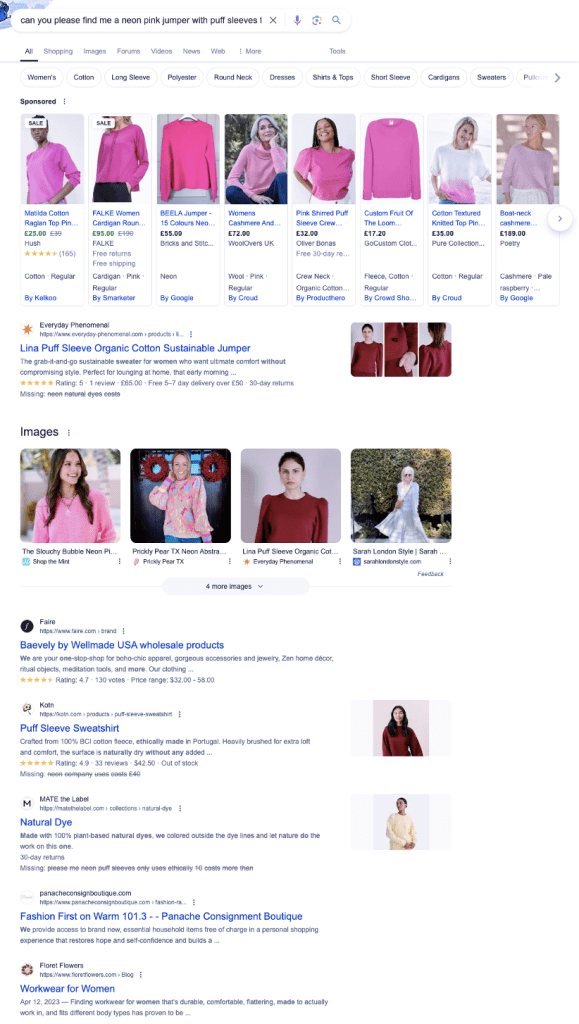
Granted, it’s not a bad search result, there’s plenty to choose from here. But if you take a better look you’ll see that it’s ignored my cost limit of £40, and now I’m not convinced of it having taken into account my requests for natural dyes and ethical sourcing. At this point, I have to do my own research.
My suspicion, is that SearchGPT will remove that dubiety, providing only results that align to the specifics of your request.
2. A more level playing field?
One of the potential benefits for smaller businesses, is that this may create a more level playing field, particularly if you run a product-based business. ChatGPT currently has a similar method of prioritising the information it shares using trust mechanics to determine what should be said. But when it comes to products, these trust identifiers become less prominent. It’s possible that items from independent suppliers such as those on Etsy may take priority over the likes of Next or Boohoo, if the correct information is provided. So your hunt for a niche item may be about to get a lot shorter.
3. Potentially fewer opportunities to appear in results
On the flip side, depending on how SearchGPT will display its responses, it’s possible that there will be fewer opportunities to appear in any one search result, because the more niche the request, the more parameters you have to fit to appear. Any relevant information omitted may result in you being left behind, so again, we could be looking at a need to be very clear in product and service descriptions.
4. Affiliations and accreditations gain importance
ChatGPT gathers its information from the internet and as it does so, it’s looking for key markers that point to relevance and importance. Those markers include mentions of a brand or person. Neil Patel recently wrote about this in his blog around the rise of SearchGPT, where he discovered that ChatGPT will already recommend specific companies, and investigated the parameters. It’s highly likely that SearchGPT will incorporate these same parameters as it builds on the new interface.
5. Social media gains importance
The popularity contest already exists on social media, but with less ability to skew the results on search engines, social media content could take on even greater significance. For social media platforms, this could mean more money, as brands scramble to pay for ads in order to gain visibility.
A lot of brands already predominantly exist on social media, and it’s possible that even more brands will choose to do so, but, a word of warning – you do so at your own risk! Not having a website puts your business solely in the hands of the powers that run the platform that you’re using. That means any changes in policy will have a huge impact on your business. Having your own website will remain important, because it’s the only space online that you can control in its entirety.
What does ChatGPT say about SearchGPT?
Just for fun, I asked ChatGPT “What is SearchGPT going to mean for the likes of Google and Bing?”
The answer was unsurprisingly cocky…
(Note that for fear of this blog being flagged as AI-generated content, I’m only including a partial response below, but you will get the gist). It said:
SearchGPT, or any similar advanced AI search tool, could significantly impact traditional search engines like Google and Bing in several ways:
Enhanced User Experience:
- Conversational Search: Users can interact with SearchGPT in a more natural, conversational manner, making search more intuitive and user-friendly.
Personalisation: AI can better understand and predict user preferences, providing more personalised and relevant search results.
At this point I think it’s worth flagging the ‘personalisation’ benefit. For years now, digital offerings have heralded personalisation as the goal. The reasons for this centre around relevance and satisfaction for the individual, however it’s worth noting that in a world of extreme personalisation, we begin to lose the opportunity to learn about other perspectives and risk missing out on ‘accidental learning’ and diversity. What might seem like a positive, can create a very singular track for the user, potentially amplify divisions and propel ignorance…
These issues have been well documented by the likes of the documentary ‘The Social Dilemma’ and researchers the Nielson Norman Group, whose analysis found that:
“Too much personalisation leads to homogenous experiences for users and can generate content fatigue and lack of diversity”.
So let’s hold fire before we claim that as a benefit. What else did ChatGPT say about how search will be affected by SearchGPT?
Other benefits included:
Advanced Query Understanding
Content Generation and Summarisation
Integration with Services and Automation
And it also raised a few ways that traditional search may struggle. Here’s what it had to say about the impact on advertising:
- Advertising Models: Traditional advertising models based on search results pages might need to evolve. New models will likely focus on integrating ads more naturally into AI interactions.
- Revenue Streams: As search paradigms shift, companies like Google and Bing will need to explore new revenue streams that leverage AI capabilities.
So there is going to be hard work ahead for traditional search engines, which around about now will be scrambling to innovate at a rate of knots. They’ve already developed their own AI engines, but will the creaky cogs of the established leaders be able to move fast enough to compete with the sophistication of OpenAI’s tools?
One thing is for sure…there are interesting times ahead!
Stay tuned as we continue to remain informed on all of the ways to gain visibility in this new era.

About the Author
Niki May Blane is founder of Big Bee Content – our ‘Queen Bee’.
Having worked cross-sector for 20 years in digital content production, she is a passionate storyteller and user advocate. Niki can most commonly be found buzzing around delivering virtual workshops and creating copious amounts of copy.